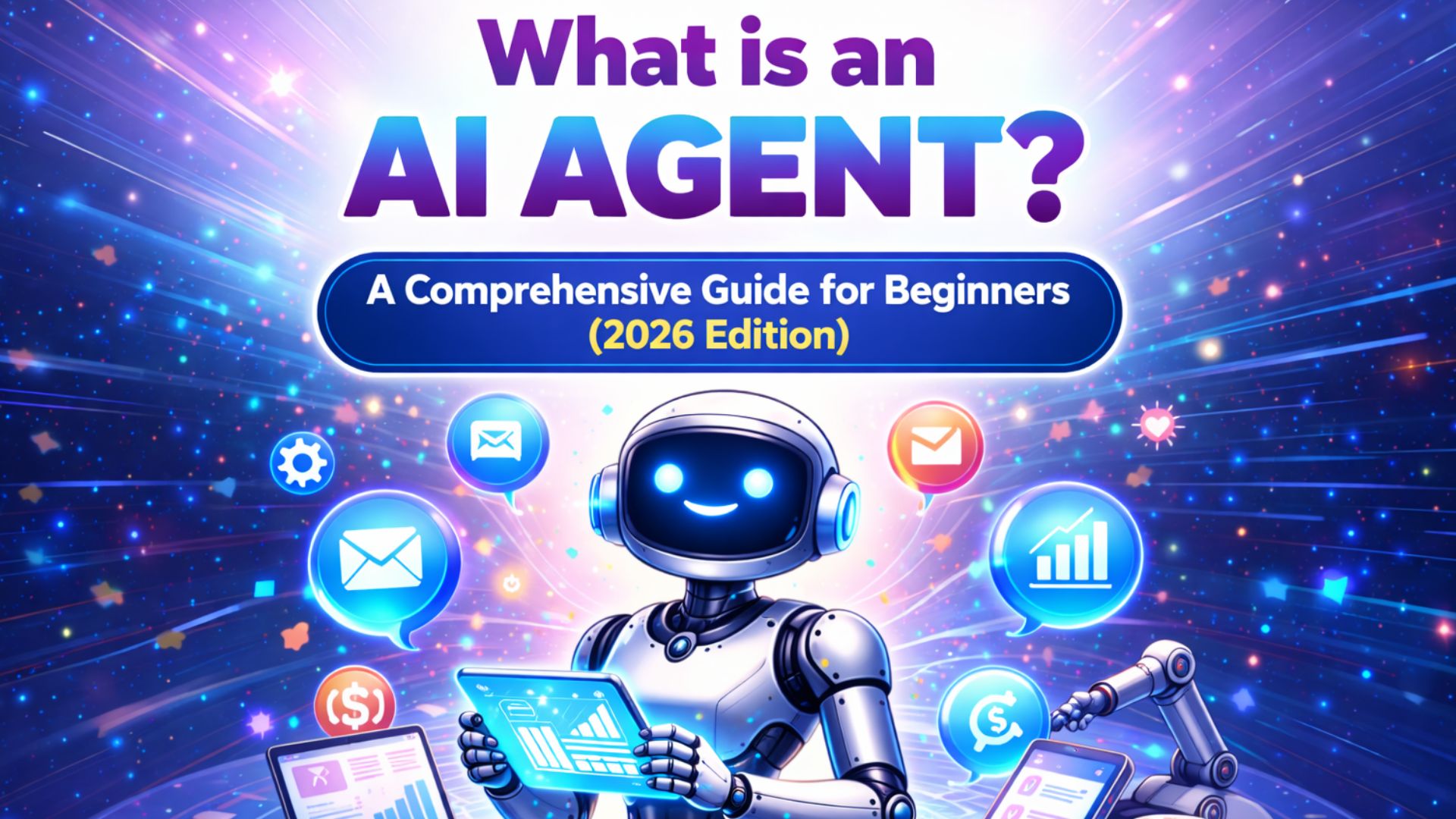

In the rapidly evolving digital landscape of 2026, we have officially moved past the era of “chatbots” and entered the age of AI Agents. If 2023 was about asking AI questions, and 2025 was about AI helping us write, 2026 is the year AI actually does the work for us.
But what exactly is an AI agent, and why is every major tech firm—from Microsoft to Google—pivoting their entire strategy toward “agentic workflows”? In this comprehensive guide, we will break down the definition, the technology, and the real-world impact of AI agents in a way that is easy to understand for beginners.
Defining the AI Agent: Moving Beyond the Chatbot
At its simplest, an AI Agent is a software system that uses artificial intelligence to pursue a specific goal autonomously. While a traditional chatbot (like the early versions of ChatGPT) waits for you to give it a prompt and then responds with text, an AI agent takes an objective and figures out the “how” on its own.
The Core Difference: Reactive vs. Proactive
-
Chatbots (Reactive): They react to your input. You ask for a summary of a document; they give it to you. The loop ends there.
-
AI Agents (Proactive): They are goal-oriented. You tell an agent, “Research the top 10 competitors in the green energy sector, summarize their 2025 fiscal reports, and draft a personalized outreach email to their CEOs.” The agent then plans, researches, and executes these steps without further prompts from you.
The “Digital Coworker” Mindset
In 2026, we think of AI agents as Digital Coworkers. They have a degree of “agency”—the ability to make decisions, use tools, and interact with other software to achieve a result.
How Do AI Agents Work? The 4 Pillars of Agentic Tech
To understand how an agent can “think” and “act” independently, we need to look at the four core components that make up its digital brain.
1. The “Brain” (Large Language Models)
The core of every AI agent is a powerful model like GPT-5, Claude 3.7, or Gemini 2.0. This acts as the reasoning engine. It understands your goal and predicts what the next best action should be.
2. Planning and Decomposition
An agent doesn’t just jump into a task. It performs Task Decomposition. It breaks a large goal (e.g., “Plan a 3-day corporate retreat”) into smaller sub-tasks:
-
Check the company calendar for available dates.
-
Research venues within a 50-mile radius.
-
Compare pricing and amenities.
-
Draft an invitation for the team.
3. Memory (Short-Term & Long-Term)
-
Short-Term Memory: This is the context of the current conversation.
-
Long-Term Memory: This allows the agent to “remember” your preferences over months, such as your preferred writing tone or specific business rules.
4. Tool Use (APIs and Integrations)
This is the “hands” of the agent. An AI agent can connect to your email, your CRM (like Salesforce), your calendar, or even your web browser to perform real-world actions.
Why 2026 is the “Year of the Agent”
Several technological breakthroughs have converged to make 2026 the tipping point for widespread adoption.
The Model Context Protocol (MCP)
One of the biggest shifts this year is the standardization of how AI agents talk to software. With the Model Context Protocol (MCP), agents can now securely connect to and understand data across different enterprise apps (like Slack, Google Drive, and Jira) without custom coding for every single integration.
Multi-Agent Systems (MAS)
We are seeing the rise of Agent Teams. Instead of one “do-it-all” AI, companies use a “Manager Agent” that coordinates specialized agents:
-
An Analyst Agent to crunch numbers.
-
A Writer Agent to draft reports.
-
A Critic Agent to check for errors and compliance.
Real-World Examples of AI Agents in Action
How are these agents actually being used in businesses today? Here are the top use cases we see at Cherry Media:
-
Customer Support 2.0: Instead of just answering FAQs, agents can now process refunds, re-book flights, and update account details by interacting directly with the company’s backend database.
-
Autonomous Research: Financial firms use agents to monitor global markets 24/7. When a specific trigger occurs (like a sudden drop in a commodity price), the agent analyzes the cause and suggests a portfolio adjustment.
-
Marketing Automation: An agent can monitor your social media engagement, identify a trending topic, draft a blog post, generate a featured image, and schedule the post—all while you sleep.
Challenges and the “Human-in-the-Loop”
As agents gain more autonomy, new challenges arise. In 2026, the focus has shifted from “Can it do it?” to “Is it safe?”
Governance and Guardrails
Companies are implementing “Kill Switches” and “Action Approvals.” For example, an agent might be allowed to draft an email but requires a Human-in-the-Loop (HITL) to click “send” if the recipient is a high-value client.
The “Hallucination” Factor
While reasoning has improved, agents can still make mistakes. Professional setups in 2026 always include a “Verifier Agent” or human oversight to ensure the autonomous actions align with business goals.
Summary: Why You Should Care
AI agents represent the most significant shift in productivity since the invention of the internet. They allow small teams to “punch above their weight” by automating the mundane, leaving humans free to focus on strategy, creativity, and high-level decision-making.
Key Takeaways for Beginners:
-
Agents act; Chatbots talk.
-
Agents use tools (Email, Browsers, Apps) to finish tasks.
-
Planning and Memory are what make them feel “intelligent.”
-
Human oversight is still the gold standard for high-stakes tasks.
Ready to Build Your Own Digital Workforce?
The transition from manual workflows to agentic automation is no longer a luxury—it’s a competitive necessity.
Whether you are looking to automate your customer service or build a custom research agent for your niche,